The AI chief of staff: running a business solo with Claude Code
Morning briefings, inbox triage, pipeline hygiene, meeting prep. The operational work a chief of staff does — done by an agent with access to your vault.
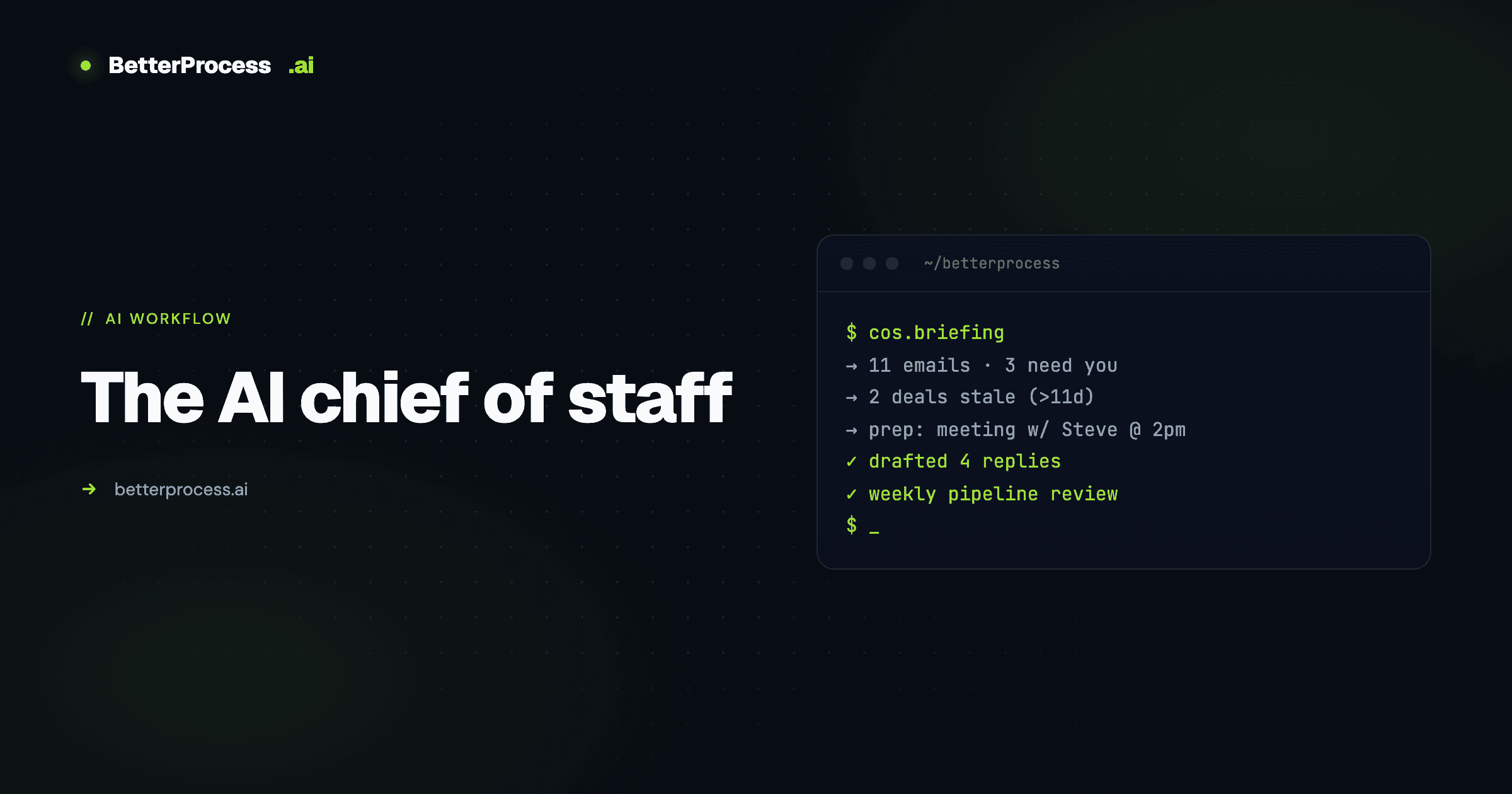
Most solo founders are drowning in the work they didn't start the company to do. Inbox triage. Calendar tetris. Status updates. Pipeline hygiene. Invoice follow-up. Every one of these is the kind of work that, in a bigger company, a chief of staff would handle quietly so the founder could focus on what moves the business.
What happens when the chief of staff is an agent?
This is a cluster post under Claude Code + Obsidian as an unfair advantage for solo founders. Here I want to focus specifically on the role — not the tool, not the architecture, but what the agent is actually doing in a day-to-day operating rhythm.
What a Real Chief of Staff Does
Before designing the agent version, get honest about the role.
A chief of staff isn't an assistant. An assistant takes instructions; a chief of staff holds context. They know where every initiative stands. They know which stakeholders need managing and what the friction points are. They prep the founder for meetings, triage what arrives at the founder's desk, and chase the things that are at risk of slipping.
The test for whether someone is actually doing the job: does the founder walk into every meeting already knowing what to expect? Does the founder find out about problems before they blow up, or after?
When you map that against what an AI agent with access to a vault and a few integrations can do, the overlap is larger than you'd think.
The Morning Briefing
The first thing a chief of staff produces for the founder is a morning briefing. Not a calendar dump — an actual briefing. What matters today, what changed overnight, what needs a decision, what's at risk.
The agent version reads everything every morning: yesterday's daily log, open tasks across projects, unread emails from contacts marked "priority," upcoming calendar events with prep notes pulled from the person files, and the current build log. It then writes a briefing in a specific format: Today's priorities, Things that moved overnight, Decisions pending, Risks to flag.
This isn't a summary. It's a prioritized read. The agent knows that the third-tier prospect isn't worth mentioning when the first-tier prospect's proposal is still sitting in draft. It knows that the marketing experiment that's been losing money for a week needs flagging, not just including.
Most founders I know spend 30 to 45 minutes every morning generating something like this for themselves, manually, from half-remembered context. Getting that back is the single highest-leverage outcome of a chief-of-staff agent.
Inbox Triage as a Full-Time Job
A chief of staff reads the inbox before the founder does. They flag what requires the founder's personal attention, draft responses to the rest, and surface patterns the founder would miss.
The agent version runs on the same heartbeat loop: every morning and again in the afternoon, it reads unread mail, classifies each message, and either drafts a response, adds a task, or flags it for human attention. The permissions are conservative — it can draft Gmail messages, it can't send them. Every response goes into a queue the founder reviews before hitting send.
But triage is more than classification. The real value is pattern recognition across time. This is the third time Steve has followed up on the contract question — it's been open for two weeks. Flag as stalled. That kind of observation requires holding context across messages, across days, across the whole operation. It's exactly what a chief of staff does, and exactly what a vault-backed agent can do well.
Pipeline Hygiene
Every solo founder has a pipeline — sales, fundraising, partnerships, hiring, whatever — and every solo founder lets it rot. Context gets lost. Follow-ups get dropped. Promising conversations go cold because nobody chased them on day eight when they should have.
The agent runs a weekly pipeline review: it reads every open deal note, checks last-contact dates against the committed follow-up window, and produces a "stale" list with specific actions. Deal X has been untouched for 11 days. The agreed next step was sending the proposal. Draft sent for your review.
The founder spends fifteen minutes on the stale list. The pipeline stays current. Nothing dies because nobody chased it.
Meeting Prep and Debrief
A chief of staff preps the founder before meetings and captures outcomes after. The agent version does the same.
Before: for every meeting on the calendar, the agent pulls the person file, recent email threads with the attendees, any open tasks or commitments tied to them, and the last meeting notes. It produces a one-page brief: Who's attending, what was the last decision, what's open, what to watch for.
After: the founder dumps a two-minute voice-note debrief. The agent transcribes it, updates the person file, creates any tasks the founder committed to, and logs outcomes into the CRM or deal tracker.
The overhead of meeting prep — which most founders skip because they're too busy — goes to zero. And the institutional memory gets built without manual effort.
The Rules That Keep the Agent Trustworthy
Three rules keep the chief-of-staff agent from going off the rails:
Draft, don't send. For anything external, the agent produces drafts the founder reviews. This preserves the founder's voice and prevents a single hallucinated detail from becoming a client-facing mistake. You can relax this over time for low-stakes categories, but start strict.
Read everywhere, write nowhere personal. The agent can read the whole vault. It can only write to the machine-side folders. Your journal, your raw brain dumps, your personal context files are read-only for the agent. This is the architectural decision from the pillar post and it's non-negotiable for a trustworthy agent.
Daily log as truth. Every action the agent takes goes into the daily log. If something was drafted, sent, updated, or flagged, there's a record. Nothing happens silently. When the agent acts in the background, you can always audit what it did at end of day.
What You Get Back
The honest pitch isn't that a chief-of-staff agent makes you 10x more productive. It's that it removes the 2–3 hours a day of operational busywork that's crushing most solo founders — the stuff that isn't why you started the company and that a real chief of staff would be doing if you had one.
That time compounds. Not into more meetings. Into the deep work that actually moves the business.
For the full architecture behind this setup, see Claude Code + Obsidian as a Solo Founder's Unfair Advantage. For the command-level details, see 27 Commands: The AI Life OS.
Want to talk through something you’re working on?
I take on a small number of consulting and build engagements each quarter. If something in this piece maps to a problem you’re trying to solve, reach out.